“I waited years to have work on my bunions. My feet Rock!”Google · Arlene Koutoulas · Mar 2021
“Dr. Patish is the best podiatrist I have had! Least pain and best recovery.”Google · Kelcey Storkersen · Feb 2026
“Awesome front desk and even better doctor. Really cares about patients — great job for the surgery.”Google · Justin Houser · Apr 2023
“He is a very experienced doctor — made me feel confident in my surgery. I was scared for 5 years.”Google · Adam Smith · Jul 2021
“This is the greatest doctor I've ever met — professional, polite, and he knows what he does.”Google · Don Jair Casas · Dec 2025
“I wish I could give Dr. Patish 10 stars!!! He has literally been a life changer.”Yelp · Troy E. · Aug 2019
“For fifteen years I saw countless doctors for pain in the ball of my foot. Dr. Patish's diagnosis was dead on.”Google · A. Holston · Jan 2023
“He is amazing — truly cares and wants me to have a better quality of life.”Healthgrades · Mar 2019
“I waited years to have work on my bunions. My feet Rock!”Google · Arlene Koutoulas · Mar 2021
“Dr. Patish is the best podiatrist I have had! Least pain and best recovery.”Google · Kelcey Storkersen · Feb 2026
“Awesome front desk and even better doctor. Really cares about patients — great job for the surgery.”Google · Justin Houser · Apr 2023
“He is a very experienced doctor — made me feel confident in my surgery. I was scared for 5 years.”Google · Adam Smith · Jul 2021
“This is the greatest doctor I've ever met — professional, polite, and he knows what he does.”Google · Don Jair Casas · Dec 2025
“I wish I could give Dr. Patish 10 stars!!! He has literally been a life changer.”Yelp · Troy E. · Aug 2019
“For fifteen years I saw countless doctors for pain in the ball of my foot. Dr. Patish's diagnosis was dead on.”Google · A. Holston · Jan 2023
“He is amazing — truly cares and wants me to have a better quality of life.”Healthgrades · Mar 2019
Minimally Invasive Bunion Surgery
Minimally invasive bunion surgery: correcting alignment through tiny incisions, in the office under local anesthesia.
 At a glance: Minimally invasive bunion surgery corrects hallux valgus through tiny incisions using fluoroscopic guidance — no large open incision required. Through tiny openings, the bone is reshaped and realigned to correct the deformity, then held in its corrected position with careful taping and immobilization — no screws, pins, or other hardware. Patients leave the office walking on their own in a surgical shoe — protected walking only — and return to regular footwear once Dr. Patish clears them, as healing allows.
A Gentler Approach to Bunion Correction
Bunion pain cramping your style (and toes)? Bunions—those bony bumps at the base of the big toe—can make every step hurt and shoe shopping a chore. Our minimally invasive bunion surgery uses tiny incisions to correct alignment. Published reviews, including a 2025 review in The Bone & Joint Journal, find the correction and results similar to open surgery. Where the two differ is the early weeks: a 2025 pain-management guideline (PROSPECT) recommends minimally invasive over open osteotomy for pain after surgery, and in a 2026 comparison patients needed less opioid pain medication in the first two weeks. Recovery is individual, and every foot heals on its own schedule.
Location Note: All minimally invasive surgical procedures are performed at our Fallbrook office (407 Potter Street, Suite A), where our surgical suite and in-office fluoroscopy are located. Fluoroscopy provides immediate imaging for surgical guidance and acute trauma. For diagnostic X-rays and MRIs (such as for tendon or ligament injuries), we refer to imaging centers in Temecula, Murrieta, Oceanside, and Carlsbad. All minimally invasive procedures are performed at our Fallbrook office. Your initial consultation can take place at either our Fallbrook or Temecula office.
What Is a Bunion and Why Does It Form?
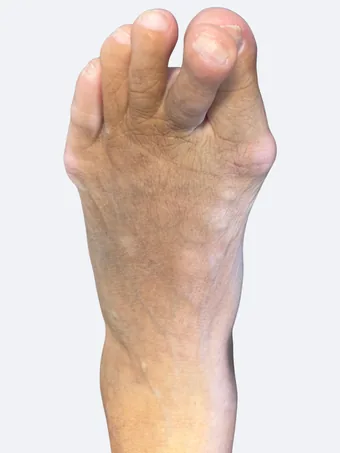
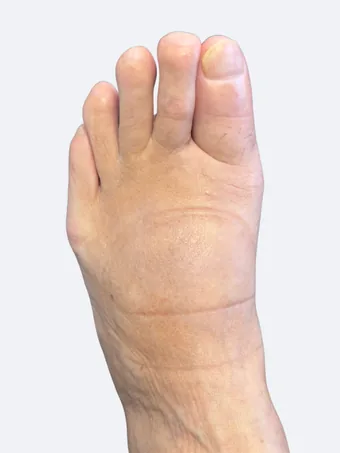
A bunion (hallux valgus) is a deformity where the first metatarsal drifts inward and the big toe angles toward the second toe, creating a prominent bump that can become swollen, painful, and arthritic.
Common Causes
- Genetics: Flat feet, lax ligaments, or a long first metatarsal.
- Footwear: Narrow or high-heeled shoes that crowd toes.
- Mechanics: Overpronation and forefoot overload.
- Arthritis & activities: Joint wear or repetitive forefoot stress.
Symptoms & Non-Surgical Care
- Pain, redness, swelling, and shoe-fit problems.
- Pads, wider shoes, splints, and custom orthotics can reduce symptoms.
- Only surgery realigns bones; the decision is based on pain and limitation.
The Evolution of Bunion Surgery: Why Minimally Invasive?
- Tiny incisions: A few tiny keyholes instead of a long incision.
- Less tissue disruption: Less soft tissue is disturbed, and the scars are much smaller and usually fade.
- Recovery: Earlier weight-bearing—often immediately in a protective shoe.
- Cosmetic benefit: Small marks that tend to fade over time.
Dr. Patish reshapes and realigns the bone through tiny openings and smooths the bony prominence as needed — all guided by live imaging.
Traditional vs. Minimally Invasive Bunion Surgery
If you have been researching bunion surgery, you have probably noticed that two very different operations share one name. Traditional open surgery and minimally invasive surgery both aim to straighten the big toe and relieve pain — but the road there is not the same.
- Incisions: Traditional open surgery uses one longer incision across the joint. The minimally invasive approach works through a few tiny openings in the skin.
- How the correction is held: In our office-based approach no hardware of any kind is implanted — the correction is maintained with specialized taping and immobilization.
- Anesthesia and setting: Traditional bunion surgery typically takes place in a hospital or surgery center, often under sedation or general anesthesia. Dr. Patish performs minimally invasive bunion surgery in the office, under local anesthesia only — you are awake, comfortable, and home shortly after.
- Early recovery: After traditional surgery, walking is often restricted for a longer stretch. With the minimally invasive approach, patients leave the office walking on their own in a surgical shoe — protected walking only. Activity builds gradually as healing allows, and regular shoes and exercise resume once Dr. Patish clears them.
- Scarring: A longer incision leaves a longer scar. Tiny openings typically fade into small marks that can be hard to find later.
A word about candidacy: no single technique fits every foot. A very severe deformity, advanced arthritis in the joint, or certain prior surgeries can make traditional reconstruction the more appropriate road. Dr. Patish has dedicated his practice exclusively to the office-based, minimally invasive approach — he does not perform open bunion surgery. If your evaluation shows a different procedure would truly serve you better, he will say so plainly and help you find the right surgeon for it.
Published evidence sets real expectations on both roads: a 2024 living systematic review and meta-analysis in Archives of Orthopaedic and Trauma Surgery reported that open and minimally invasive techniques both correct the deformity effectively, that patient-rated outcomes improved similarly across approaches, and that modern minimally invasive procedures showed possibly superior correction of the bunion angle itself.
How We Perform Minimally Invasive Bunion Correction
- Preoperative planning: Standing X-rays determine severity and precise correction.
- Anesthesia: Local ankle block — no sedation needed.
- Tiny incisions: 2–3 small portals to access bone and soft tissues.
- Bone corrections: The bone is reshaped and realigned through tiny openings using a specialized low-speed burr and confirmed with real-time X-ray; the correction is held with taping and immobilization rather than hardware.
- Soft-tissue balancing: Minimal, targeted releases or tightening if indicated.
- Closure & dressing: Small stitch or tapes, compression wrap, and protective shoe or boot.
Benefits Recap
- Pain: Many patients manage with OTC pain meds within days.
- Earlier ambulation: Heel/outer-foot weight bearing right away in many cases.
- Scarring: Tiny marks that typically fade; smaller incisions also mean less exposed tissue.
- Recovery: Regular shoes often within a couple of months; bone keeps healing after that.
What to Expect After MIS Bunion Surgery
Early Phase
- First days: Elevation, icing near the ankle, keep dressing dry; mild throbbing is common.
- 1st visit (a few days): Dressing check; stitches often removed after the first few weeks.
- Weight bearing: Usually heel/outer foot immediately in a surgical shoe.
Recovery & Return
- several weeks: Transition to a supportive sneaker if X-rays show healing.
- Motion & PT: Gentle toe mobility; exercises if stiffness persists.
- After several weeks: Regular shoes; low heels after several months as tolerated.
- Long-term: Straighter toe, better shoe fit; low recurrence with proper care.
Tip: Smart footwear and, when advised, custom orthotics help protect your correction long-term.
Kick Bunions to the Curb – Contact Us Today
Life’s too short to live with bunion pain. If wide shoes and pads aren’t cutting it, minimally invasive surgery may be the answer. We’ll examine your foot, take X-rays, and give a clear recommendation—so you know exactly where you stand before deciding.
What to Expect: Your Recovery Timeline
Typical phases for many patients — everyone heals at their own pace. See the note below.
Day of Surgery Walk Out in a Surgical Shoe 
Tiny incisions, local anesthesia, no hospital stay. You leave the office walking on your own in a protective surgical shoe — protected walking only until Dr. Patish clears you for regular shoes and activity.
First Few Days First Dressing Change
Return for your first dressing change and wound check. Keep foot elevated and dressing dry until this visit.
Early Healing Weekly Follow-Ups
Weekly dressing changes and wound monitoring. Continue heel/outer-foot weight bearing in the surgical shoe. Avoid icing if you have diabetes, gout, or poor circulation.
As Swelling Settles Transition to Sneakers
X-rays confirm healing. Transition to a supportive sneaker. Gentle toe mobility exercises begin.
Returning to Activity Back to Regular Shoes
Regular shoes and normal activities. Low heels after several months as tolerated. Straighter toe, better shoe fit.
Everyone heals at their own pace. The timeline above reflects what many patients experience and lines up with published research on minimally invasive foot surgery — but it’s a general guide, not a promise. Your recovery and your final result depend on things we can’t standardize: your age and circulation, whether you smoke, conditions like diabetes, your bone quality, how involved your case was to begin with, and how closely you follow your recovery plan. Yours may move faster, slower, or simply look a little different. Dr. Patish will walk you through what to expect for your specific situation.
Whether you're managing a bunion conservatively or preparing for surgery, our bunion rehabilitation exercise guide can help strengthen the supporting muscles and slow progression.
Learn more from OrthoInfo (AAOS): Bunions and ACFAS.
See Bunion Rehab Exercises →Ready to get started? Our team typically sees patients within a few days. Call (760) 728-4800 or book online to schedule your visit.
Serving Fallbrook, Temecula & Nearby Communities
If you have been searching for bunion surgery near me, Dr. Patish treats patients from across the region. All minimally invasive bunion procedures are performed at our Fallbrook office; initial consultations are available at either our Fallbrook or Temecula location. Patients travel to us for bunion surgery from Fallbrook, Temecula, Murrieta, Menifee, Vista, Oceanside, Bonsall, San Marcos, Escondido, and the surrounding North County San Diego and Southwest Riverside communities.
Insurance & Self-Pay
We accept most major insurance plans and will verify your benefits before any care begins, so you know where you stand. If your plan does not cover bunion surgery, we offer competitive self-pay pricing. Cherry and CareCredit financing are available. Our team is happy to walk you through your options — application and approval are handled directly by the lender, and any terms are set by them, not by our office.
What to Expect at Your Visit
Your first visit starts with a focused evaluation and any imaging needed to understand what is going on. Dr. Patish will explain your options in plain language and answer your questions before anything is decided. There is never pressure — the goal is the right plan for you. To get started, call (760) 728-4800 or book online.
Frequently Asked Questions
How is minimally invasive bunion surgery different from traditional?
Traditional bunion surgery uses a large incision and extensive tissue dissection. Dr. Patish’s minimally invasive technique uses tiny incisions, a specialized instrument, and real-time X-ray guidance to correct the alignment with far less tissue disruption.
How long is recovery from minimally invasive bunion surgery?
Patients leave the office walking on their own in a surgical shoe — protected walking only. Regular shoes, normal walking and exercise resume once Dr. Patish clears you. Bunion correction has the longest timeline of our in-office procedures — clearance is often a couple of months out — and it varies from person to person. Healing continues well beyond that.
Will my bunion come back after surgery?
Recurrence rates for properly performed bunion surgery are low — typically a small percentage. Wearing appropriate footwear and using orthotics as recommended helps maintain the correction.
Does minimally invasive bunion surgery leave a big scar?
Usually not. The incisions are very small and tend to heal to small marks that are hard to find later, though scarring varies from person to person.
When should I consider bunion surgery?
Surgery is considered when conservative measures — wider shoes, orthotics, padding — no longer manage the pain and the bunion interferes with daily activities or footwear.