
“I have plantar fasciitis and Doctor was very patient, providing exercises and answers. I'm seeing improvement for the first time in months.”Google · Sean Murray · Jun 2023
“He finally freed me from my plantar fasciitis! Orthotics he casted are exceptional.”Google · Gleb Kartsev · Nov 2021
“Best orthotics ever! Before — horrible pain from plantar fasciitis heel spurs. Best arch support ever!”Google · Weilian Tang · Nov 2021
“Dr Patish and his staff are great! Ingrown nail and plantar fasciitis — he helped immensely with both!”Google · Polly Trump · Mar 2023
“Doctor took very good care of my plantar fasciitis problem — quick and effective.”Google · Judy Wahl Talley · Apr 2019
“Dr. Patish's orthotics have changed my life! I can walk for hours with no pain.”Google · Sarah Tang · Mar 2022
“For fifteen years I saw countless doctors. Dr. Patish was the only one that got it right.”Google · A. Holston · Jan 2023
“I wish I could give Dr. Patish 10 stars!!! He has literally been a life changer.”Yelp · Troy E. · Aug 2019
“I have plantar fasciitis and Doctor was very patient, providing exercises and answers. I'm seeing improvement for the first time in months.”Google · Sean Murray · Jun 2023
“He finally freed me from my plantar fasciitis! Orthotics he casted are exceptional.”Google · Gleb Kartsev · Nov 2021
“Best orthotics ever! Before — horrible pain from plantar fasciitis heel spurs. Best arch support ever!”Google · Weilian Tang · Nov 2021
“Dr Patish and his staff are great! Ingrown nail and plantar fasciitis — he helped immensely with both!”Google · Polly Trump · Mar 2023
“Doctor took very good care of my plantar fasciitis problem — quick and effective.”Google · Judy Wahl Talley · Apr 2019
“Dr. Patish's orthotics have changed my life! I can walk for hours with no pain.”Google · Sarah Tang · Mar 2022
“For fifteen years I saw countless doctors. Dr. Patish was the only one that got it right.”Google · A. Holston · Jan 2023
“I wish I could give Dr. Patish 10 stars!!! He has literally been a life changer.”Yelp · Troy E. · Aug 2019
Shockwave Therapy for Plantar Fasciitis: How It Works and Who It Helps
When stretching, orthotics, and rest haven't resolved your heel pain, shockwave therapy offers a non-invasive option that stimulates real healing. Here's what to know.
You've been stretching your calves, wearing supportive shoes, maybe even using custom orthotics — and your plantar fasciitis has improved, but it's still there. That nagging first-step pain in the morning. The ache that returns after a long day. You're better than you were, but you're not fixed.
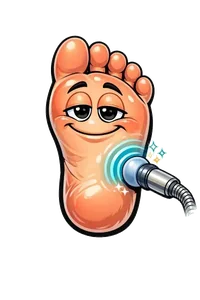
This is the patient who benefits most from focused shockwave therapy. It's designed specifically for chronic soft tissue conditions that haven't fully responded to first-line conservative treatment.
What Shockwave Therapy Actually Is
Extracorporeal shockwave therapy (ESWT) delivers focused acoustic pressure waves into the damaged tissue. Despite the dramatic name, these aren't electrical shocks. Think of them as precisely targeted sound waves — similar in principle to the technology used to break up kidney stones, but calibrated for musculoskeletal tissue.
When these pressure waves reach the chronically inflamed plantar fascia, they do several things at the cellular level: they stimulate new blood vessel formation (neovascularization), trigger the body's natural tissue repair processes, break down calcified scar tissue that's accumulated from chronic inflammation, and release growth factors that promote healing.
In simpler terms, shockwave therapy essentially "restarts" the healing process in tissue that has become stuck in a chronic inflammatory cycle.
What the Treatment Feels Like
The device is applied directly to the heel and arch area. Each session takes about 15–20 minutes. You'll feel a rhythmic tapping sensation — some describe it as intense, others as mildly uncomfortable. The intensity is adjustable, and we work within your comfort level. No anesthesia is needed, and you walk out of the office immediately afterward.
Most treatment protocols involve 3–5 sessions spaced one to two weeks apart. There's no downtime between sessions — you can return to your normal activities the same day, though we typically recommend avoiding high-impact exercise for 24–48 hours after each treatment.
Who Benefits Most
Shockwave therapy sits in a specific and valuable place in the treatment ladder: it's for patients who have tried conservative measures (orthotics, stretching, ice, anti-inflammatory medication) for at least 6–8 weeks without adequate relief. This is the group that historically had few options between "keep doing what you're doing and hope it improves" and surgical intervention.
Shockwave therapy fills that gap. Clinical studies report success rates of 70–80% for chronic plantar fasciitis, with "success" defined as significant pain reduction and return to normal activity. That's a meaningful number for a non-invasive, outpatient procedure with essentially no recovery period. More about our shockwave therapy.
What It Doesn't Do
Setting realistic expectations matters. Shockwave therapy stimulates a healing response, but that response takes time. Most patients notice gradual improvement over 4–12 weeks following the treatment course, not instant relief. Some feel a difference within days, while others see the full benefit closer to the 3-month mark.
It also doesn't address the biomechanical factors that caused the plantar fasciitis in the first place. If flat feet, overpronation, or poor footwear contributed to the condition, those factors need to be managed with orthotics and appropriate shoes — otherwise the fascia can become re-irritated even after successful treatment. Read our guide on orthotics.
Shockwave vs. Other Advanced Options
We offer several advanced pain therapies, and the right choice depends on your specific situation:
- Shockwave therapy is best for chronic tendon and fascia conditions where the tissue has become stuck in an incomplete healing cycle. It works by stimulating biological repair.
- Laser therapy reduces inflammation and pain at the cellular level and can be combined with shockwave for a synergistic effect. More about laser and H-Wave therapy.
- Minimally invasive plantar fasciotomy is the surgical option for severe, refractory cases — a small release of the fascia through a tiny incision. This is reserved for patients who haven't responded to any conservative or advanced therapy. More about plantar fasciotomy.
The practical takeaway: If you've been dealing with heel pain for more than 2–3 months and first-line treatments have plateaued, shockwave therapy is the logical next step before considering anything more involved. It's effective for the majority of chronic cases, it's done in-office, and there's no recovery period to plan around.
Ready to discuss whether shockwave therapy is right for your heel pain? Schedule a consultation or call (760) 728-4800.
Frequently Asked Questions
How effective is shockwave therapy for plantar fasciitis?
Studies show 70–80% of patients with chronic plantar fasciitis experience significant improvement with focused shockwave therapy, making it one of the most effective non-surgical options for stubborn heel pain.
How many shockwave sessions do I need?
A typical course is 3–5 weekly sessions. Many patients notice improvement after just 2–3 treatments, with continued healing over the following 8–12 weeks.
Does shockwave therapy hurt?
You'll feel rhythmic tapping that can range from mildly uncomfortable to moderately intense over the tender area. Intensity is adjustable, and each session lasts only about 5–10 minutes.
Ready to Feel Better?
Most patients are seen within 24–48 hours. Schedule your visit today.