
“I have plantar fasciitis and Doctor was very patient, providing exercises and answers. I'm seeing improvement for the first time in months.”Google · Sean Murray · Jun 2023
“He finally freed me from my plantar fasciitis! Orthotics he casted are exceptional.”Google · Gleb Kartsev · Nov 2021
“Best orthotics ever! Before — horrible pain from plantar fasciitis heel spurs. Best arch support ever!”Google · Weilian Tang · Nov 2021
“Dr Patish and his staff are great! Ingrown nail and plantar fasciitis — he helped immensely with both!”Google · Polly Trump · Mar 2023
“Doctor took very good care of my plantar fasciitis problem — quick and effective.”Google · Judy Wahl Talley · Apr 2019
“Dr. Patish's orthotics have changed my life! I can walk for hours with no pain.”Google · Sarah Tang · Mar 2022
“For fifteen years I saw countless doctors. Dr. Patish was the only one that got it right.”Google · A. Holston · Jan 2023
“I wish I could give Dr. Patish 10 stars!!! He has literally been a life changer.”Yelp · Troy E. · Aug 2019
“I have plantar fasciitis and Doctor was very patient, providing exercises and answers. I'm seeing improvement for the first time in months.”Google · Sean Murray · Jun 2023
“He finally freed me from my plantar fasciitis! Orthotics he casted are exceptional.”Google · Gleb Kartsev · Nov 2021
“Best orthotics ever! Before — horrible pain from plantar fasciitis heel spurs. Best arch support ever!”Google · Weilian Tang · Nov 2021
“Dr Patish and his staff are great! Ingrown nail and plantar fasciitis — he helped immensely with both!”Google · Polly Trump · Mar 2023
“Doctor took very good care of my plantar fasciitis problem — quick and effective.”Google · Judy Wahl Talley · Apr 2019
“Dr. Patish's orthotics have changed my life! I can walk for hours with no pain.”Google · Sarah Tang · Mar 2022
“For fifteen years I saw countless doctors. Dr. Patish was the only one that got it right.”Google · A. Holston · Jan 2023
“I wish I could give Dr. Patish 10 stars!!! He has literally been a life changer.”Yelp · Troy E. · Aug 2019
How to Choose Running Shoes for Your Foot Type: A Podiatrist's Guide
The wrong running shoes can cause foot pain, shin splints, and injuries. A podiatrist explains how to match your foot type to the right shoe for pain-free running.
Walk into any running store and you'll face a wall of shoes with names like "stability," "neutral," "motion control," and "minimalist." The terminology is confusing, and the staff — however well-intentioned — aren't medical professionals. As a podiatrist who treats running injuries every week, here's what actually matters when choosing running shoes.
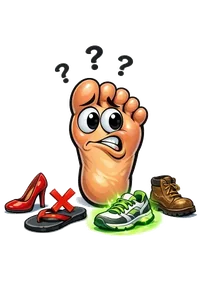
Know Your Foot Type First
Your foot type determines how your foot distributes impact forces with every stride. The three basic categories are flat feet (low or collapsed arches that overpronate), neutral feet (normal arch height with balanced pronation), and high arches (rigid feet that underpronate or supinate). The American Podiatric Medical Association recommends getting a professional gait analysis to accurately determine your foot type before investing in running shoes.
A simple wet test — stepping on paper with a wet foot — gives a rough idea, but it doesn't account for how your foot behaves dynamically while running. This is why we recommend a biomechanical evaluation, especially if you've had recurring injuries.
Matching Shoes to Foot Type
Flat feet / overpronation: Look for stability or motion control shoes with firm midsole support on the medial (inner) side. These shoes counteract the inward rolling motion that puts excess stress on the arch, ankle, and knee. Avoid minimalist or highly flexible shoes.
Neutral feet: You have the widest selection. Neutral cushioned shoes work well, providing shock absorption without excessive correction. Avoid heavy motion control shoes that could interfere with your natural gait.
High arches / supination: Choose neutral shoes with generous cushioning and flexibility. High arches create a rigid foot that doesn't absorb shock efficiently, so extra cushioning compensates. Avoid stability shoes, which would further limit your foot's already restricted range of motion.
Beyond Foot Type: Other Critical Factors
Foot type is the starting point, but several other factors matter. Proper sizing means your thumb's width of space between your longest toe and the shoe end. Your feet swell during runs, so shoes that feel snug in the store will feel tight at mile three.
Replace running shoes every 300–500 miles. The cushioning breaks down before the outsole shows wear. Running on dead shoes is one of the most common causes of overuse injuries we see.
When Shoes Aren't Enough
If you're experiencing persistent foot pain despite wearing appropriate shoes, the shoes may not be the problem — or at least not the whole problem. Custom orthotics can address biomechanical issues that even the best shoe can't correct. Our foot and ankle exercise guide also includes runner-specific stretching and strengthening routines.
The best running shoe is the one that matches your biomechanics. If you've been dealing with recurring running injuries, a podiatric evaluation can identify the structural factors that shoe choice alone can't fix.
The Bottom Line
Running shoes matter — but they're one piece of the puzzle. Understanding your foot type, getting properly fitted, and replacing shoes on schedule will prevent many common injuries. For persistent issues, professional evaluation gives you answers that no shoe store can. More foot care tips for runners.
Frequently Asked Questions
How do I know my foot type for running shoes?
A wet test gives a rough idea, but a professional gait analysis is more accurate. A podiatrist can evaluate your arch height, pronation pattern, and dynamic biomechanics to recommend the right shoe category and determine if orthotics would help.
How often should I replace my running shoes?
Every 300-500 miles, or roughly every 4-6 months for regular runners. The midsole cushioning breaks down before the outsole shows visible wear, so running on 'dead' shoes is a common cause of overuse injuries.
Can the wrong running shoes cause foot pain?
Absolutely. Shoes that don't match your foot type can worsen overpronation, fail to absorb impact for high arches, or create pressure points that lead to conditions like plantar fasciitis, shin splints, and stress fractures.
Ready to Feel Better?
Most patients are seen within 24–48 hours. Schedule your visit today.